


Table of Contents
- What non-toxic skincare for face actually means
- Skincare ingredients to avoid and why they matter
- Building a gentle skincare routine for sensitive skin
- How to patch test skincare products safely
- Hypochlorous acid spray for face: A different approach
- Non-toxic skincare for different skin types and concerns
- Making non-toxic skincare work in your routine
- Frequently Asked Questions
Last Updated: October 19, 2026
What non-toxic skincare for face actually means
Non-toxic skincare for face isn't marketing jargon, it's a practical approach to minimizing exposure to ingredients many people want to avoid.
"Non-toxic" isn't a regulated term, and the FDA doesn't certify skincare as toxic or non-toxic.
Clean beauty and non-toxic skincare overlap but aren't identical: clean beauty emphasizes natural or plant-based ingredients, while non-toxic skincare focuses on avoiding specific harmful compounds.
The benefit is practical: fewer irritants mean fewer reactions, especially for sensitive, eczema-prone, rosacea-prone, or acne-prone skin.
Skincare ingredients to avoid and why they matter
Most "ingredients to avoid" lists treat every flagged compound as equally dangerous, which is not how toxicology works. Risk depends on the ingredient, the dose, how long it sits on your skin, and whether your barrier is intact. This section separates legitimate concerns from overhyped ones.
The terms that actually matter
"Non-toxic" and "clean" are not regulated claims, and no single agency maintains a definitive banned-ingredient list for skincare. Regulators rely on hazard identification, exposure assessment, and risk characterization. When a brand says "non-toxic," ask which of those three it means.
Ingredients with the strongest evidence for concern
Fragrance and "parfum." This is the highest-value item to avoid if you have sensitive, eczema-prone, or rosacea-prone skin.
Formaldehyde releasers. Preservatives such as DMDM hydantoin, diazolidinyl urea, imidazolidinyl urea, and quaternium-15 slowly release small amounts of formaldehyde to prevent microbial growth.
Methylisothiazolinone (MI) and methylchloroisothiazolinone (MCI). These preservatives are potent contact allergens and have been restricted in leave-on cosmetics in the EU.
Certain essential oils and botanical extracts. "Natural" does not mean non-irritating. Citrus oils (limonene, linalool, citral), peppermint, eucalyptus, and lavender are common sensitizers, especially in leave-on products. Many "clean" brands swap synthetic fragrance for essential oils and inadvertently raise allergy risk.
Ingredients with weaker or overstated concerns
Parabens. The endocrine-disruption concern comes largely from high-dose animal and in vitro studies.
Sulfates. Sodium lauryl sulfate (SLS) is a known irritant, especially at higher concentrations and in frequent-use products, but the concern is irritation, not systemic toxicity, and many people tolerate sulfates fine.
Mineral oil and petrolatum. These occlusives sit on the surface and slow water loss. The claim that they "trap bacteria" or "smother" skin is not supported for cosmetic-grade, highly purified ingredients.
Retinoids. Retinol, retinal, and prescription tretinoin are not "toxic," but they are potent and irritating, especially in the first weeks.
How to read an ingredient list like an editor
Ingredients are listed in descending order of concentration until 1%, after which order is flexible, so the first five to seven ingredients tell you most of what the product is. If water, glycerin, and a gentle emollient lead, the base is likely mild; if fragrance or a preservative appears before the beneficial ingredients, the formula is prioritizing scent or shelf life. Also check "fragrance-free" versus "unscented" (unscented can still contain masking fragrance).
| Ingredient group | Main concern | Evidence strength | Practical guidance |
|---|---|---|---|
| Fragrance / parfum | Allergic contact dermatitis, hidden allergens | Strong for sensitive skin | Choose fragrance-free if reactive |
| Formaldehyde releasers | Sensitization, allergy | Moderate at cosmetic doses | Avoid if patch-test positive |
| MI / MCI | Contact allergy | Strong | Avoid in leave-on products |
| Essential oils (citrus, mint) | Sensitization | Moderate | Patch test; prefer fragrance-free |
| Parabens | Endocrine activity at high doses | Weak at cosmetic doses | Personal choice; not a proven cosmetic risk |
| Sulfates | Irritation, barrier stripping | Strong for irritation | Switch if skin feels tight |
| Mineral oil / petrolatum | Occlusion, texture | Weak for toxicity | Fine for most; avoid if acne-prone and heavy |
| Retinoids | Irritation, photosensitivity | Strong | Introduce slowly; daily SPF |
Building a gentle skincare routine for sensitive skin
A gentle routine for sensitive skin starts with subtraction, not addition. Most people with reactive skin have tried too many products; the fix isn't another miracle serum, it's stripping back to essentials.
Cleansing and makeup removal
Your cleanser should remove dirt and makeup without disrupting your barrier. That "squeaky clean" feeling is a warning sign; look for cream cleansers or micellar water that dissolve makeup without scrubbing.
For sensitive skin, avoid foaming cleansers; they rely on aggressive sulfates to create lather. A good gentle cleanser should feel almost oily, that's the emollient base doing its job.
If you wear makeup, start with a gentle oil or balm to dissolve it, then follow with your regular cleanser to prevent over-scrubbing. Acne-prone skin can use a slightly more active cleanser, but nothing harsh enough to leave skin feeling stripped.
Hydration and protection
After cleansing, hydration is non-negotiable. A hydrating toner or essence adds water, a lightweight serum with glycerin or hyaluronic acid suits most skin types, and moisturizer locks it in.
For sensitive skin, moisturizers should be fragrance-free and without essential oils or botanical extracts that can trigger reactions; ceramides and niacinamide strengthen the barrier without irritation. Sunscreen is the final, non-negotiable step even on cloudy days, since UV damage accelerates aging and worsens inflammation in reactive skin.
How to patch test skincare products safely
Patch testing prevents wasting money and time on products your skin will reject.
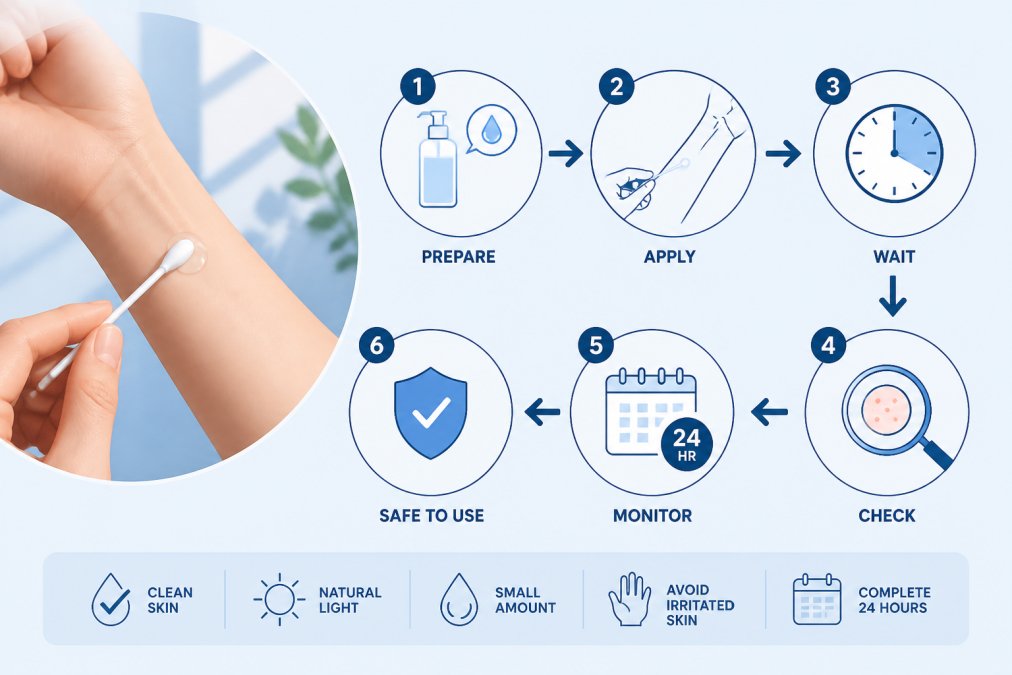
Apply a small amount to clean, dry skin and leave the area alone for 24 hours, no other skincare, makeup, or friction. Watch for redness, itching, burning, or swelling; some reactions are immediate, others take hours.
Even if the patch test passes, introduce the product slowly: every other day for the first week, then daily if tolerated.
Keep a simple log of what you test and the results. Over time you'll spot patterns, maybe a reaction to certain plant extracts or preservatives, and can avoid those ingredients.
Hypochlorous acid spray for face: A different approach
Hypochlorous acid is a compound your immune system produces to fight bacteria. Used topically, it's gaining traction because it's gentle.
Hypochlorous Acid Spray for Face and Skin - 240mL / 8oz →

e11ement's Hypochlorous Acid Spray for Face and Skin is formulated without alcohol, parabens, added fragrance, gluten, dyes, or oils, making it genuinely non-toxic skincare for face.
Its versatility sets it apart: it works for acne-prone skin, calms inflammation in sensitive skin, and hydrates. Athletes use it post-workout, and people with eczema or rosacea find it soothing.
The spray format matters: no mixing or waiting, just spray, let it air dry, and move on.
Non-toxic skincare for different skin types and concerns
Skin type is only half the story: two people with oily skin can need very different routines if one has acne and the other has rosacea. The routines below start with the fewest steps that keep your barrier intact, then add one product at a time, assuming fragrance-free, non-comedogenic basics and daily broad-spectrum SPF.
Sensitive and reactive skin
Morning: rinse with lukewarm water or a cream cleanser, apply a fragrance-free hydrating serum (glycerin or hyaluronic acid), follow with a ceramide moisturizer, then mineral or fragrance-free chemical SPF 30+.
Evening: cream cleanser, optional hypochlorous acid mist to calm redness, ceramide moisturizer. No exfoliants, no essential oils, no "calming" botanicals until your barrier is stable for at least two weeks.

What to avoid: foaming cleansers with SLS, anything labeled "cooling" (often menthol or peppermint), and products with multiple plant extracts, since each is a potential allergen.
Acne-prone and oily skin
Morning: gentle gel or cream cleanser, optional 2% salicylic acid toner two to three times a week (not daily at first), lightweight oil-free moisturizer, SPF 30+ gel or fluid.
Evening: cleanser, hypochlorous acid mist or a low-strength benzoyl peroxide (2.5%) on active spots only, oil-free moisturizer. Introduce salicylic acid and benzoyl peroxide on alternate nights rather than stacking them.
Trade-off to know: benzoyl peroxide is effective but bleaching and irritating; hypochlorous acid is gentler and non-bleaching but slower. Many people use hypochlorous acid daily and reserve benzoyl peroxide for flare-ups.
Dry and combination skin
Morning: cream cleanser or water rinse, hydrating serum, richer ceramide moisturizer on dry areas, lighter lotion on the T-zone, SPF.
Evening: cream cleanser, hydrating serum, moisturizer adjusted by area, and an occlusive balm on dry patches only. For combination skin, apply a lightweight moisturizer all over, then a thicker cream just on cheeks and jaw.
What to avoid: alcohol-heavy toners and foaming cleansers that leave skin tight. Dry skin often improves more from a ceramide moisturizer than from another serum.
Rosacea-prone skin
Rosacea is a vascular and inflammatory condition, not just "sensitive skin." Common triggers include heat, sun, alcohol, spicy food, and strong actives. Keep the routine minimal: fragrance-free cream cleanser, ceramide moisturizer, and daily SPF. Avoid scrubs, retinoids at first, and anything with menthol or eucalyptus. Hypochlorous acid mist can help redness for some, but introduce it alone so you can tell what is working.
Eczema-prone skin
Treat the barrier as the priority: fragrance-free cream cleanser, a thick ceramide or petrolatum-based moisturizer applied within three minutes of bathing, and SPF. Avoid essential oils, fragrance, and exfoliants. If flares are frequent, see a dermatologist; non-toxic skincare supports daily care for eczema.
A simple decision rule
If your skin is reacting, subtract before you add: drop to cleanser, moisturizer, and SPF for two weeks, then reintroduce one product every two weeks, patch testing first. It's slower than buying a new "miracle" product, but it's the only reliable way to learn what your skin tolerates.
Making non-toxic skincare work in your routine
The biggest mistake people make is treating skincare as a collection of products rather than a system.
Start with the basics: cleanser, moisturizer, and sunscreen are non-negotiable, everything else is optional.
Budget matters too. The e11ement Hypochlorous Acid Spray for Face and Skin - 60mL costs just $12.49, making it accessible for people building a routine on a budget.
Consistency beats complexity: a simple routine you'll actually follow beats an elaborate one you abandon after two weeks.
Building a non-toxic skincare routine for your face is about understanding what your skin actually needs and avoiding unnecessary irritation.
Frequently Asked Questions
What does non-toxic skincare for the face actually mean?
Non-toxic skincare avoids ingredients that can cause irritation or accumulate in your body over time. It doesn't mean 'all natural', it means formulas free from parabens, phthalates, synthetic fragrances, and other ingredients many people want to avoid. The goal is effective skincare that supports skin health without unnecessary chemical exposure. Products like e11ement's hypochlorous acid spray achieve this by using simple, dermatologist-tested ingredients that work with your skin, not against it.
Which skincare ingredients should I avoid if I have sensitive skin?
Sensitive skin reacts to alcohol and synthetic fragrances. Avoid products with high concentrations of essential oils and harsh exfoliants. Instead, look for fragrance-free formulas with minimal ingredient lists. Hypochlorous acid is valued for sensitive skin because it's derived from a naturally occurring compound and formulated without alcohol or added fragrance, making it gentle enough for reactive skin types including those with rosacea or eczema.
Can I use hypochlorous acid spray for face every day?
Yes, hypochlorous acid spray for face is designed for daily use as part of your skincare routine. It can be used after cleansing and before moisturizer, or as a refreshing mist throughout the day, especially after workouts. The 0.015% concentration in e11ement's formula is gentle enough for daily application across all skin types. Simply spray onto clean skin and allow to air dry before applying other products. Many users incorporate it as a core step rather than an occasional treatment.
How do I know if a skincare product is truly non-toxic?
Check the ingredient list for parabens, phthalates, synthetic fragrances, and formaldehyde releasers. Look for dermatologist testing or third-party verification. Transparent brands list exactly what's in the product and why, not vague terms like 'fragrance' or 'natural blend.' e11ement's products show exact concentrations and are formulated without alcohol, parabens, added fragrance, gluten, dyes, or oils. Read labels carefully, and if a brand won't disclose ingredients or testing, that's a red flag.


