


Last Updated: October 25, 2026
Quick Summary
No, hypochlorous acid is not the same as bleach, even though both are chlorine-based disinfectants sharing the same active chlorine. The difference comes down to chemical form, pH, and charge, which change how each behaves on skin, surfaces, and in storage.
- Bleach is sodium hypochlorite, which dissociates in water, while HOCl stays largely intact as a neutral molecule at the right pH.
- HOCl is neutral and moves through cell membranes more readily, while the negatively charged OCl⁻ ion enters microbial cells more slowly.
- For light, frequent, low-odor tasks like counters, toys, and gym gear, a surface-sanitizing HOCl product is a reasonable daily choice per label.
- For heavy soil, mold, stain removal, and laundry whitening, bleach remains the stronger tool when used safely.
- Never mix chlorine-based products with acids, ammonia, hydrogen peroxide, or other cleaners, as mixing can release irritating gases.
Table of Contents
- Hypochlorous Acid vs Bleach: The Core Difference in One Comparison
- Chemical Composition: Same Active Chlorine, Different Chemical Form
- How pH and Charge Decide Which Form Dominates
- Can Hypochlorous Acid Replace Bleach in Your Cleaning Routine?
- Hypochlorous Acid Safety: Handling, Storage and What the Labels Mean
- What Not to Mix With Hypochlorous Acid
- Hypochlorous Acid Spray for Skin: What to Look For and How to Use It
- Choosing Your Hypochlorous Acid Spray
- Frequently Asked Questions
Hypochlorous Acid vs Bleach: The Core Difference in One Comparison
No, hypochlorous acid is not the same as bleach, even though both are chlorine-based disinfectants sharing the same active chlorine. The difference comes down to chemical form, pH, and charge, which change how each behaves on skin, surfaces, and in storage.
Here is the short version most guides bury under three paragraphs of chemistry. A 2026 comparison from Vegalab's hypochlorous acid vs bleach guide notes that hypochlorous acid (HOCl) and sodium hypochlorite bleach (NaOCl) carry the same active chlorine, and that pH determines which form dominates in solution. That single sentence explains almost everything else: why one is sold as a facial mist and the other comes with a hazard label.
| Question | Hypochlorous Acid (HOCl) | Bleach (Sodium Hypochlorite) |
|---|---|---|
| Chemical form | Mostly undissociated HOCl at near-neutral pH | Mostly dissociated OCl⁻ at alkaline pH |
| Typical pH | Slightly acidic to near-neutral | Strongly alkaline |
| Charge | Neutral molecule | Negatively charged ion |
| Common use | Skin care, wound care, surface sanitizing | Laundry, hard-surface disinfection |
| Skin contact | Formulated for direct use | Not formulated for skin |
Below, we cover the chemistry, the pH effect, safety, mixing rules, and how to pick a skin spray that actually holds up.
Chemical Composition: Same Active Chlorine, Different Chemical Form
Both products deliver chlorine, and that is where the similarity ends. Bleach is a solution of sodium hypochlorite, a salt that dissociates in water. Hypochlorous acid is the same chlorine atom in a different arrangement, staying largely intact as a neutral molecule at the right pH.
The WHO Expert Committee application document on hypochlorous acid treats HOCl as a distinct substance from sodium hypochlorite, which matters if you are reading labels or regulatory filings. A 2020 review published in PubMed Central's hypochlorous acid review describes HOCl as the active antimicrobial species produced by the human immune system, which is part of why it appears in skin and wound products rather than cleaning aisles.
Hypochlorous acid is a weak acid formed when chlorine dissolves in water, existing in equilibrium with its salt form depending on pH. That equilibrium is the whole story.
How pH and Charge Decide Which Form Dominates
pH decides whether you get HOCl or its charged cousin, hypochlorite ion (OCl⁻). Push the solution alkaline and the equilibrium shifts toward OCl⁻; keep it near neutral or slightly acidic and HOCl dominates.
Charge matters. HOCl is neutral, so it moves through cell membranes more readily; OCl⁻ carries a negative charge that slows its entry into microbial cells.
This is also why the claim that HOCl is "100 times more effective than bleach" needs a caveat. Scientific American's coverage of HOCl has reported the comparison, but without the specific organisms, concentrations, and test conditions, it does not prove HOCl is universally stronger.
Can Hypochlorous Acid Replace Bleach in Your Cleaning Routine?
| Context | Better fit | Why | Key caveat |
|---|---|---|---|
| Daily kitchen counters and food-prep surfaces | HOCl (surface-sanitizing product) | Low odor, less residue concern, gentler on many materials | Use a product labeled for food-contact surfaces; follow contact time |
| High-chairs, toys, pet areas | HOCl | Convenient for frequent use; less lingering odor | Still allow surfaces to dry; keep pets away during application |
| Bathroom grout, mold, heavy soil | Bleach (sodium hypochlorite) | Stronger oxidizing power for stubborn growth and stains | Ventilate; never mix with acids or ammonia |
| Laundry whitening and stain removal | Bleach | Whitening and stain-fighting performance | Check fabric care labels; do not mix with other cleaners |
| Post-gym equipment, yoga mats | HOCl | Low-odor, convenient for quick wipe-downs | Clean visible soil first; follow label dwell time |
| Wound care or skin | Neither unless labeled for that use | Intended-use labeling governs | Do not use cleaning-grade products on skin |
Why concentration and contact time matter more than the product name. Efficacy depends on the organism, available chlorine concentration, pH, contact time, and test method.
Surface compatibility. Bleach is alkaline and oxidizing; it can discolor fabrics, corrode certain metals, and damage some natural stone or grout sealants.
Stability and storage change the calculus. HOCl degrades faster than bleach, especially with light, heat, and air exposure; a bottle left in a hot car or uncapped will not perform like a fresh one.
A simple rule of thumb. For light, frequent, low-odor tasks, counters, toys, gym gear, a surface-sanitizing HOCl product is a reasonable daily choice when used per label. If you plan to dilute for cleaning, choose a concentrated format with clear dilution instructions, such as Hypochlorous Acid - e11ement X Concentrated - 30mL / 1oz, and measure carefully.

Hypochlorous Acid Safety: Handling, Storage and What the Labels Mean
HOCl is generally gentler than bleach, but "gentler" is not "risk-free." The CDC's chemical disinfectants guidance attributes chlorine's microbicidal activity largely to undissociated HOCl, which is exactly why concentration, contact time, and intended use still matter.
Regulatory status and label interpretation. In the United States, surface disinfectant and sanitizer claims are regulated by the EPA, while skin-care and cosmetic claims fall under FDA oversight.
A practical label checklist. When comparing HOCl products, verify:
- Active ingredient and concentration, look for hypochlorous acid and a stated percentage (for example, 0.015% in some skin sprays).
- pH, if listed, note whether it is near-neutral or slightly acidic, since pH affects which form dominates.
- Intended use, skin, food-contact surfaces, or general hard surfaces. Do not cross uses.
- Contact time, how long the surface must stay wet to achieve the claimed kill.
- Expiration or production date, HOCl degrades over time; honor the date.
- Manufacturer testing, look for stated test methods or claims that match the intended use.
- Storage instructions, light, heat, and air exposure accelerate degradation.
Safe handling and storage. Keep bottles out of direct sunlight; UV accelerates degradation. Cap tightly between uses and store at room temperature, not in a hot car or freezing garage.
Hypochlorous Acid Spray for Face and Skin - 240mL / 8oz →
Mixing rules. Never mix HOCl with other cleaning chemicals. Combining chlorine-based products with acids or ammonia can release irritating gases, and combining them with other disinfectants can cancel out the active chlorine.
If you want a larger concentrated format with full label details for dilution planning, Hypochlorous Acid - e11ement X Concentrated - 60mL / 2oz is the size we point people toward. Always follow the dilution instructions on the label rather than guessing.
What the labels mean in practice. A cosmetic-grade mist and a cleaning-grade solution are not the same product even when the active ingredient matches. For skin, choose a product labeled for cosmetic or skin use with a transparent ingredient list. For surfaces, choose a product labeled for that surface and follow the contact time. When in doubt, ask the manufacturer what their product is and is not tested for.
What Not to Mix With Hypochlorous Acid
Never mix HOCl with other cleaning chemicals, full stop. Combining chlorine-based products with acids or ammonia can release irritating gases, and combining them with other disinfectants can cancel out the active chlorine entirely.
The short list of things to keep separate:
- Ammonia-based glass and surface cleaners
- Vinegar, citric acid, and other acidic descalers
- Hydrogen peroxide
- Rubbing alcohol
- Drain cleaners and anything strongly alkaline
Use one product, let the surface dry, then use the next if you must. Never pour leftovers together to "save space," and never decant HOCl into an old bleach bottle.
Hypochlorous Acid Spray for Skin: What to Look For and How to Use It
For skin, choose a cosmetic-grade hypochlorous acid spray with a short, transparent ingredient list and a stated concentration. e11ement's face and skin sprays use water, sodium chloride, and hypochlorous acid at 0.015%, with no alcohol, parabens, added fragrance, gluten, dyes, or oils.
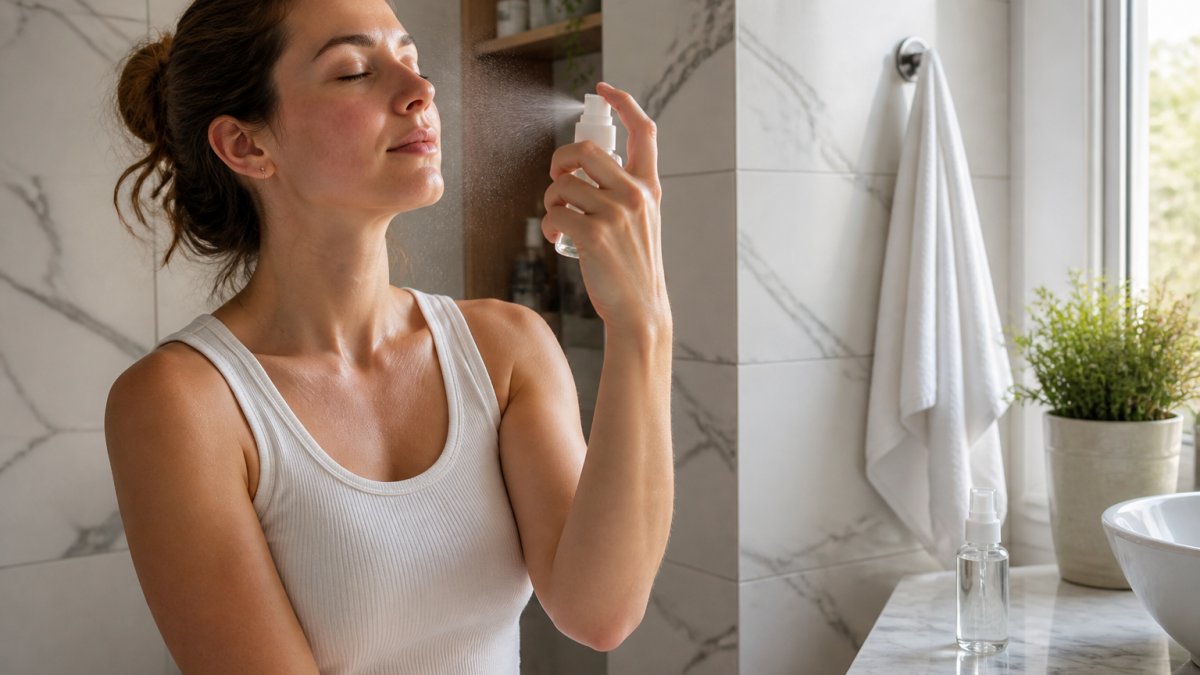
How we suggest using it:
- Cleanse and pat dry.
- Mist onto clean skin from about 15 cm away, eyes closed.
- Let it air dry before layering serum or moisturizer.
- Use morning and night, or after workouts when skin feels hot and sweaty.
If you are new to HOCl and want a low-commitment entry point, Hypochlorous Acid Spray for Face and Skin - 60mL / 2oz is the smallest format.

Choosing Your Hypochlorous Acid Spray
Size and concentration are the two decisions that matter most. Pick based on how often you spray and where the bottle lives.
| Product | Price | Best for |
|---|---|---|
| Face and Skin Spray | $12.49 | First-time trial, travel bag |
| Face and Skin Spray | $15.99 | Desk or gym bag, daily use |
| Face and Skin Spray | $18.95 | Bathroom counter, everyday routine |
| e11ement X Concentrated | $13.99 | Spot treatment, clogged pores |
| e11ement X Concentrated | $17.99 | Longer-run spot treatment supply |
Best for: daily post-workout and morning routine use, the 240mL spray. Skip if: you only want to test tolerance, in which case start with the 60mL.

Best for: targeted acne, ingrown hairs, and razor bumps, the e11ement X 30mL. Skip if: you want an all-over facial mist, because this is a spot treatment.
Most people overbuy their first bottle. Start small, confirm your skin likes it, then size up.
The real question is not whether hypochlorous acid matches bleach on every surface, because it does not, and it does not need to.
Frequently Asked Questions
Is hypochlorous acid just watered-down bleach?
No. Hypochlorous acid (HOCl) and bleach (sodium hypochlorite, NaOCl) are different chemical compounds, even though both contain chlorine. A 2026 Vegalab guide notes they carry the same active chlorine, but pH determines which form dominates. At a near-neutral pH, the active form is HOCl; in bleach, it is the hypochlorite ion. Diluting bleach does not convert it into hypochlorous acid, so the two should not be treated as interchangeable.
Can I use hypochlorous acid instead of bleach for cleaning?
For light surface disinfection, hypochlorous acid can work, but it is not a direct swap for bleach in every job. Bleach is far more concentrated and is used for whitening laundry and heavy-duty cleaning, which hypochlorous acid is not designed for. Hypochlorous acid also degrades faster, so check the label for concentration and shelf life. Use it on hard, non-porous surfaces and follow the contact time on the product.
Is hypochlorous acid safer than bleach?
Hypochlorous acid is generally gentler on skin and surfaces than bleach, but safety depends on concentration and use. Household bleach is alkaline and can irritate skin and damage some materials, while cosmetic hypochlorous acid sprays are formulated at low concentrations for daily use. Even so, hypochlorous acid safety still requires keeping it out of eyes and mouth, storing it away from sunlight, and never mixing it with other cleaners.
What should not be mixed with hypochlorous acid?
Do not mix hypochlorous acid with ammonia, vinegar, or other acidic cleaners, because these can release chlorine gas. Avoid combining it with hydrogen peroxide or other disinfectants, since the mixture can reduce how well either one works. Keep it separate from bleach as well. If you are switching products on the same surface, rinse and let the surface dry between them.
Can hypochlorous acid be used on skin?
Yes, cosmetic-grade hypochlorous acid sprays are made for skin. e11ement's Hypochlorous Acid Spray for Face and Skin uses water, sodium chloride and 0.015% hypochlorous acid, and is formulated without alcohol, parabens, added fragrance, gluten, dyes or oils. Spray onto clean skin and let it air dry before applying other products. It is designed for sensitive skin, post-workout refreshing and daily use.


